

Language is not just a collection of sounds and letters, it is considered to be the container of thoughts, ideas, and human experience. Indeed, it is the key that opens the door of knowledge and understanding. If we need to comprehend any piece of information, we will need to rely on a language whether spoken or written or even a sign language.
Humans around the world speak different languages and belong to different cultures and traditions. This diversity creates richness and distance. Therefore, there must be a way of “transforming” these culture specifics from a language to another. This process of transforming is known as translation.
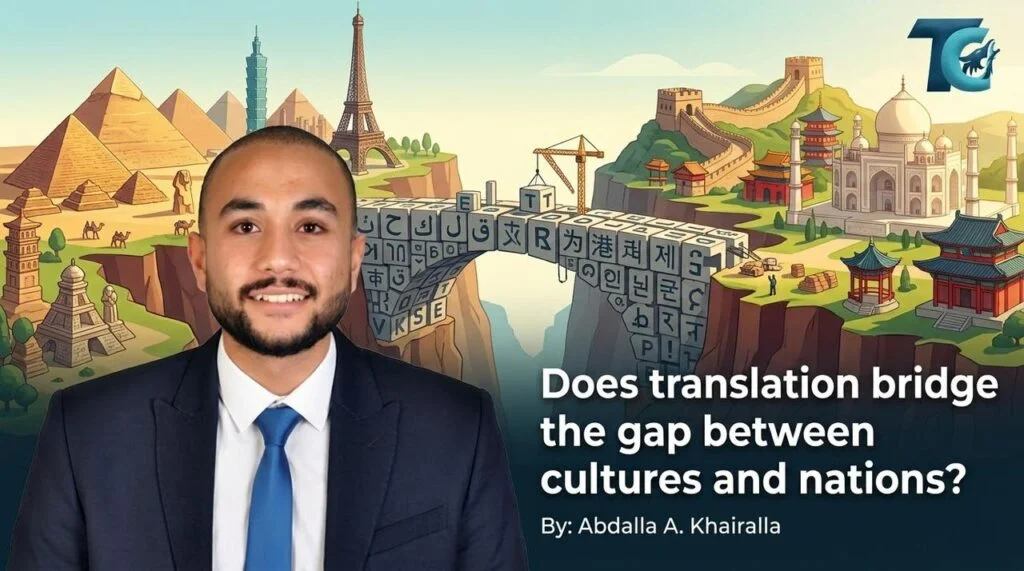
Translation is an essential human activity existed since the early existence of mankind. It worked as a bridge between cultures allowing people to communicate with each other cross borders. Without translation, communication between nations would be so limited and a lot of knowledge would be inaccessible out of ignorance. In this sense, translation is not just transforming words from a source text to a target one, It conveys the meanings, context, and cultural nuance.
Translation played a vital role in transforming scientific knowledge and had a significant impact on nations out of this knowledge transformation. Throughout history, great civilizations recognized the value of translation in strengthening their societies. Intellectual rulers invested heavily in translation movements out of their understanding that access to foreign knowledge could empower their nation. Translators were highly respected and rewarded generously for their work, it is recorded in some historical books that some rulers used to reward translators with gold equal to the weight of the books they translated. This highlights the fact of the value of their contribution in building a knowledgeable society. Through our search effort in the scientific, philosophical and literary fields knowledge got transformed from a nation to another.
Translation was one of the main reasons for central power to be moved from a nation to another. So we can say that translation is not only a bridge between cultures and nation but also it is a main factor key for improvement and ruling.
Translation was one of the main reasons for central power to be moved from a nation to another. So we can say that translation is not only a bridge between cultures and nation but also it is a main factor key for improvement and ruling.
Nowadays, the importance of translation has increased in an increasingly globalized world. Communication across cultures became a must more than ever. Countries now recognize the significance of translation in diplomacy, education, technology and business. As a result of that most universities around the world have established specialized departments dedicated to translation studies and interpretation. These institutions aim to train professional translators who are capable of accuracy while conveying meaning between languages. Such professionals play a wider role in both sharing knowledge with the global community and bringing external knowledge into their own societies.
It’s important to acknowledge that translation is not always an easy challenge, transforming culture specifics, idiomatic expressions, or emotional nuances can be a difficult task. Despite these challenges, skilled translators strive to minimize misunderstanding and seek accuracy as much as possible by using techniques and theories such as “domestication and foreignization”. In conclusion, we can say translation bridges the gap between cultures, it enables communication effectively, promotes the exchange of knowledge between cultures, and deepens the understanding of others. Even though it may have some challenges, it would remain one of the most powerful tools of connecting humans together.
You can find more article by Translation Club here!
For Arabic articles by Translation Club, check here!